Aicumene preprint 2026.046v2 Working paper, version 2 October 24, 2026
Version 1 was posted on April 12, 2026 (Aicumene:2026.046v1); the accompanying talk is registered as doi:10.13140/RG.2.2.20527.50087. Version 2 updates the companion references to their current versions and completes the bibliography with persistent identifiers.
Abstract
The New Cognitive Paradigm (NCP) argues that the central problem of artificial intelligence is no longer whether a system can imitate human outputs, but whether cognition itself can be made structurally measurable.
It replaces behavioural, anthropocentric, and purely phenomenological accounts of intelligence, consciousness, language, and truth with a measurement programme based on internal organization: intrinsic dimensionality, topology, functional regimes, semantic trajectories, memory-like persistence, recovery, and controlled state transitions.
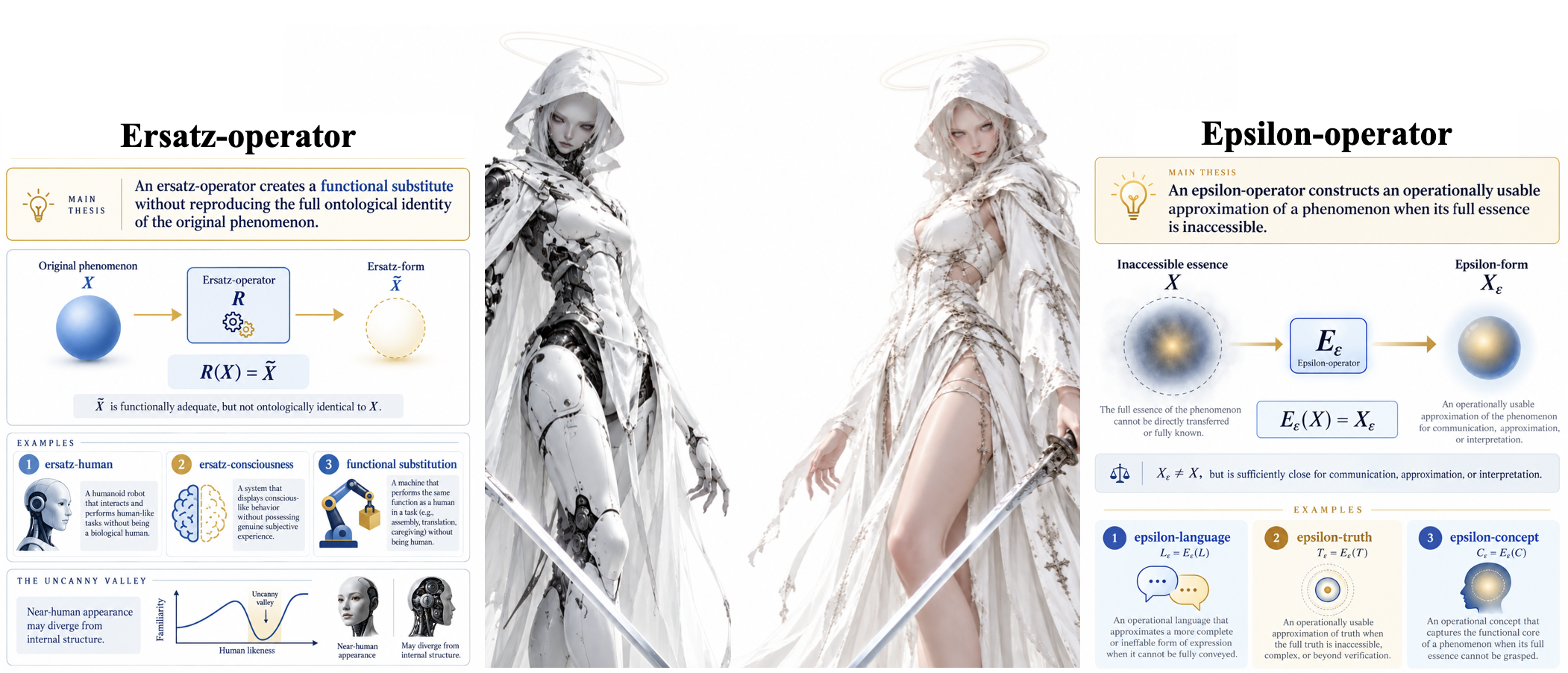
The paper introduces three operational instruments of this paradigm: the epsilon-operator, which constructs a usable near-form of an inaccessible phenomenon; the ersatz-operator, which produces a functional substitute without ontological identity; and the operator of measurability, which turns subjective, interpretive, and phenomenological phenomena into structurally addressable objects (Figure 1).
Within this framework, strong artificial intelligence is not defined as human-like performance, but as measurable structural excess beyond the training envelope. Consciousness is treated as a structurally measurable and potentially modifiable regime rather than only a private phenomenological state. Language becomes semantic state transfer, including intercortical languages, human–machine languages, and machine-to-machine languages. Truth becomes probabilistic truth, understood not as relativism, but as measurable access to truth under generative uncertainty.
If the level of consciousness is determined by structure and dynamics, then consciousness is not only describable but also trainable: the NCP opens the possibility of inducing, stabilizing, and amplifying desired conscious or near-conscious regimes through directed neuroplasticity, brain–computer interfaces, neurofeedback, and controlled regime modulation.
The NCP therefore proposes a new criterion for the post-generative era: to distinguish intelligence from imitation, consciousness from ersatz-consciousness, language from token sequence, and truth from fluent plausibility by measuring and shaping the internal structures that make cognition possible.
Keywords: strong artificial intelligence; probabilistic truth; trusted generative AI; structural intelligence; semantic trajectories; BOID; MSSA; language topology; intercortical language; machine-to-machine language; artificial cognition; AI safety; measurable consciousness; measurable creativity.
1. Introduction
Artificial intelligence is usually evaluated from the outside. A system is asked a question, given a task, placed in an environment, or tested on a benchmark, and its performance is measured by the quality of its output. This approach is useful, but incomplete. It treats intelligence as a behavioural phenomenon and leaves open a deeper question: what internal structure, if any, corresponds to intelligence?
The April Theses of the New Cognitive Paradigm (NCP) propose that intelligence, language, truth, consciousness, safety, and creativity should be treated as measurable structural phenomena. A system should not be called intelligent merely because it produces convincing outputs. The internal organization of the system matters: the dimensionality of its state space, the topology of its trajectories, the stability of its representations, the presence of functional regimes, and the way it transitions between them.
This distinction becomes especially important for strong artificial intelligence (SAI). If SAI is understood not as imitation of human behaviour, but as the emergence of intrinsic cognitive organization, then external performance is insufficient. A system may pass behavioural tests while lacking structural autonomy, memory organization, regime switching, or internally grounded truth-evaluation. Conversely, the transition toward strong AI may begin before a system appears human-like, if it develops measurable internal structures that support cognition.
The April Theses therefore shift the focus from imitation to measurement. They ask not only whether an artificial system gives the right answer, but what kind of internal object produces that answer.
1.1 The Previous Cognitive Paradigm
The previous cognitive paradigm was built around the human subject, phenomenological experience, language as representation, truth as verifiable or falsifiable correspondence, and intelligence as rational or observable behaviour. It gave powerful tools for science, philosophy, and cognition, but it left unresolved the question of measurable internal structure. The New Cognitive Paradigm does not cancel verification, falsification, or phenomenology; it transfers them into a structural domain. What must be verified is not only the statement, but the trajectory by which it was produced. What must be described is not only experience, but the measurable organization of the state. What must be evaluated is not only intelligent behaviour, but the internal structure that makes such behaviour possible.
Thesis 1. The previous cognitive paradigm was anthropocentric
The previous cognitive paradigm placed the human subject at the centre of cognition. Knowledge, perception, language, truth, and consciousness were understood primarily through the position of the experiencing, thinking, speaking, and judging subject.
The previous paradigm measured intelligence, language, and consciousness against the human being. The human subject was the implicit norm.
Thesis 2. Truth was understood through verification, falsification, and correspondence
In the previous paradigm, truth was mainly defined through the relation between a statement and the world. A proposition was considered meaningful or scientific if it could be verified, tested, confirmed, or falsified.
Karl Popper’s criterion of falsifiability made scientific knowledge dependent on the possibility of error, refutation, and empirical testing. A theory was scientific not because it could be finally proven, but because it could expose itself to possible disproof.
This remains one of the strongest achievements of the previous paradigm. However, it does not yet answer the question central to the New Cognitive Paradigm: How is a truth-claim produced, traced, weighted, and structurally stabilized?
The previous paradigm defined scientificity through method: observation, experiment, reproducibility, falsifiability, logical coherence, and evidence.
This was powerful and necessary. But the cognitive act itself — the production of knowledge, the trajectory of reasoning, the formation of meaning, the emergence of error — remained largely outside structural measurement.
Thesis 3. Consciousness was treated phenomenologically
The previous paradigm understood consciousness through experience, intentionality, perception, self-givenness, and subjective presence. This phenomenological approach gave a deep language for describing lived experience, but it did not provide a universal structural measure of conscious states.
Intelligence was understood through rationality, behaviour, or human-like performance. In the previous paradigm, intelligence was often associated with logical reasoning, rational consistency, problem-solving, or observable behaviour. In artificial intelligence, this became especially visible in behavioural criteria such as imitation, task performance, and human-like response.
Consciousness remained qualitative rather than structurally measurable. The previous paradigm had rich descriptions of consciousness: wakefulness, attention, perception, memory, sleep, self-awareness, and subjective experience. Yet these categories were often qualitative, behavioural, or report-based.
Thesis 4. Language was treated as representation
The previous paradigm treated language mainly as a system of signs, meanings, references, rules, and representations. Language expressed thought, described the world, or organized cultural meaning.
This approach made language a medium of representation. It did not yet treat language as a dynamical trajectory space in which meaning, error, truth, hallucination, and manipulation can be structurally measured.
2. The New Cognitive Paradigm
2.1 Instruments of the New Cognitive Paradigm
The New Cognitive Paradigm relies on three operational constructions: the epsilon-operator, the ersatz-operator, and the operator of measurability. Together, they define a new conceptual language for working with phenomena that are inaccessible in their full essence, functionally imitated without ontological identity, or previously treated as merely subjective, interpretive, or phenomenological phenomena (Figure 1).
Epsilon-operator.
The New Cognitive Paradigm introduces the term epsilon-operator to denote an operation that transforms an inaccessible, unstable, incomplete, or non-transferable phenomenon into an approximate, sufficiently close, and functionally usable form. The epsilon-operator does not capture the phenomenon itself; it constructs an -neighbourhood around it in which operation, communication, interpretation, or measurement becomes possible.
Formally, where is the inaccessible or non-transferable phenomenon, and is its operational epsilon-form. The relation is essential: the epsilon-form is not identical to the phenomenon, but it is close enough to make interaction with it possible.
Thus, an epsilon-language, epsilon-truth, or epsilon-concept allows a system to operate under conditions where the full essence of a phenomenon is inaccessible, incomplete, unstable, or impossible to transmit directly. This construction is especially important for qualia, perception, meaning, and information transfer: even if a quale cannot be fully transmitted, an epsilon-pattern may be sufficiently close to change the receiving system in the intended direction.
Ersatz-operator.
The New Cognitive Paradigm introduces the term ersatz-operator to denote an operation that produces a functional substitute for a phenomenon without reproducing its full ontological or structural nature. Unlike the epsilon-operator, which constructs an approximate neighbourhood of an inaccessible essence, the ersatz-operator constructs a replacement that can perform a similar role, produce a similar effect, or occupy a similar position in a system while remaining non-identical to the original phenomenon.
Formally, where is the original phenomenon and is its ersatz-form. The relation is essential: the ersatz-form may be functionally adequate, behaviourally convincing, or operationally useful, but it does not possess the same ontological status as .
Thus, an ersatz-human may reproduce human-like behaviour, speech, emotional expression, or social presence without being a human subject. Ersatz-consciousness may reproduce signs associated with consciousness—self-description, affective language, continuity of dialogue, apparent intention, or reflective style—without necessarily possessing the internal structural organization of conscious experience. The ersatz-operator therefore allows the New Cognitive Paradigm to distinguish between functional substitution and ontological identity.
The epsilon-operator produces a near-form of a phenomenon; the ersatz-operator produces a substitute-form. The epsilon-form remains oriented toward the inaccessible essence of , whereas the ersatz-form replaces functionally without guaranteeing ontological continuity with it.
Near-consciousness, the near-human, and the uncanny valley.
The New Cognitive Paradigm reframes the uncanny valley as a cognitive instrument rather than merely an affective disturbance. The near-human and the near-conscious system are unsettling because they occupy an intermediate structural zone: they are no longer simple objects, yet they do not satisfy the full criteria of human consciousness, personhood, or subjectivity. In the previous paradigm, this ambiguity was experienced primarily as uncanniness: something looks almost human, speaks almost humanly, or behaves almost consciously, but remains ontologically uncertain. In the New Cognitive Paradigm, this uncertainty becomes measurable.
The uncanny valley marks the region in which external anthropomorphic similarity diverges from internal structural organization. It is therefore not only a psychological reaction, but also a diagnostic space for distinguishing imitation from consciousness, ersatz-humanity from genuine subjecthood, and behavioural fluency from measurable cognitive structure.
The near-human is not simply a failed copy of the human. It is a boundary object that reveals which structural properties are necessary for consciousness, agency, language, affect, and trust. Thus, near-consciousness and the near-human transform the uncanny valley from a zone of fear into a zone of measurement: a place where the difference between appearance and internal organization can be studied.
The uncanny valley is the phenomenological signature of the ersatz-operator: the point at which functional human-likeness becomes sufficient to trigger recognition, but insufficient to establish ontological continuity with the human subject.
Operator of measurability.
The third construction is measurability. The New Cognitive Paradigm introduces measurability not as a reduction of complex phenomena to numerical scores, but as an operation that makes them structurally addressable. Intelligence, consciousness, language, truth, creativity, and their products can be studied through internal structural-dynamical properties: intrinsic dimensionality, topology, oscillatory organization, trajectory geometry, functional regimes, complexity, sparsity, fractality, memory-like persistence, recovery, and state transitions.
Formally, where is the phenomenon under study, denotes intrinsic dimension, topology, functional regimes, trajectories in state space, complexity, and structural change over time.
Measurability does not claim that a phenomenon is exhausted by these quantities. Rather, it claims that what was previously treated only as subjective, interpretive, or phenomenological can also be studied through internal dimension and dynamics. A conscious state, a language, a truth-claim, an artwork, an artificial agent, or a near-human system becomes accessible not only through description, but through structural diagnosis.
Together, the epsilon-operator, the ersatz-operator, and the operator of measurability define the operational language of the New Cognitive Paradigm. The epsilon-operator allows us to work near the essence when the essence itself is inaccessible. The ersatz-operator allows us to distinguish functional substitution from ontological identity. The operator of measurability allows us to move from impression, metaphor, and interpretation toward structural diagnosis. In this sense, the New Cognitive Paradigm does not eliminate uncertainty, approximation, or imitation; it gives them names, boundaries, and measurable forms.
2.2 What the NCP Changes
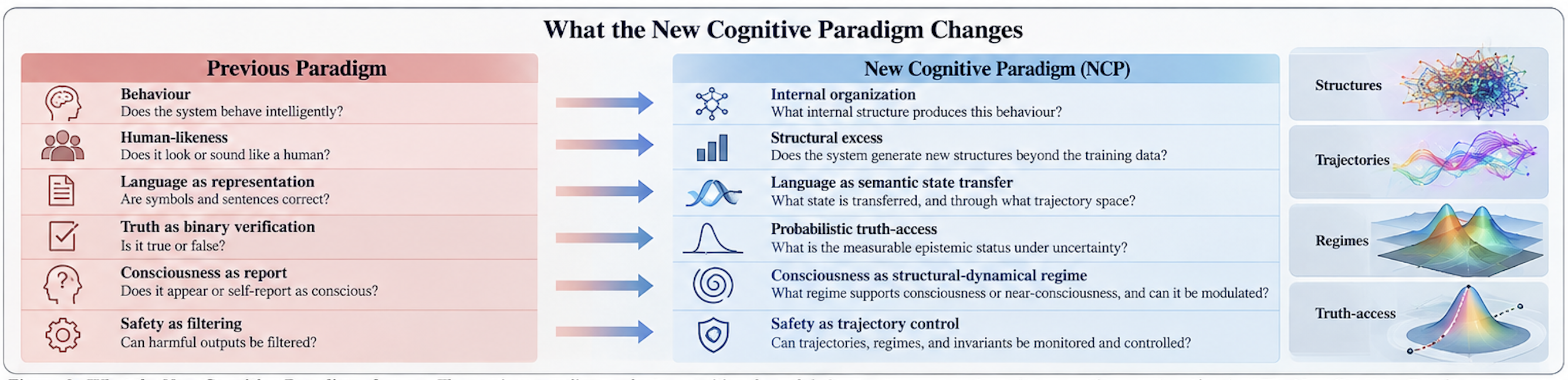
The previous paradigm asks whether a system behaves intelligently; the NCP asks what internal structure produces this behaviour. The previous paradigm asks whether an output is true or false; the NCP asks what the measurable epistemic status of truth-access is. The previous paradigm asks whether a system appears conscious; the NCP asks what structural-dynamical regime supports consciousness or near-consciousness. The previous paradigm asks whether a system uses language; the NCP asks what semantic state is transferred, through what medium, and along what trajectory.
The NCP does not ask whether machines can imitate mind; it asks what structure makes mind more than imitation (Figure 2).
3. Structural Domains of the New Cognitive Paradigm
The New Cognitive Paradigm does not reject the previous one. It transforms it. Every cognitive epoch develops its own instruments and its own spaces; the April Theses ask what the measuring instruments of the next cognitive paradigm should be. The following sections apply the operational instruments of the NCP to intelligence, consciousness, language, and truth.
3.1 Intelligence
3.1.1 Intelligence as a Structurally Measurable Dynamical Process
Thesis. Intelligence is not merely an input–output behaviour, but a structured dynamical process whose emergence must be assessed through measurable internal invariants: intrinsic dimension, BOID, topology, complexity, functional regimes, trajectories, and structural change.
A behavioural definition asks what a system does; a structural definition asks what internal organization makes this behaviour possible. This distinction is central: behaviour can be copied, simulated, or optimized without the emergence of strong intelligence. A system may generate fluent text, classify images, solve tasks, or imitate reasoning without possessing stable regimes of memory, attention, recovery, abstraction, self-maintenance, or controlled transition. The structural programme for strong AI begins where behavioural imitation becomes insufficient [1].
The April Theses propose that intelligence and consciousness should be studied through measurable invariants: intrinsic dimension and topology [1], BOID and regime-dependent brain-state dynamics [5, 6], MSSA-based oscillatory structure [3, 4], semantic trajectories [22, 21], and dynamical invariants of trained systems [6]. These invariants can be summarized as where denotes intrinsic dimension, denotes Bernadotte Oscillator Intrinsic Dimension, denotes topology of trajectories, denotes Kolmogorov complexity, denotes functional regimes, denotes the system’s trajectory through state space, and denotes structural change in dimension across time or task phases.
Experimental basis.
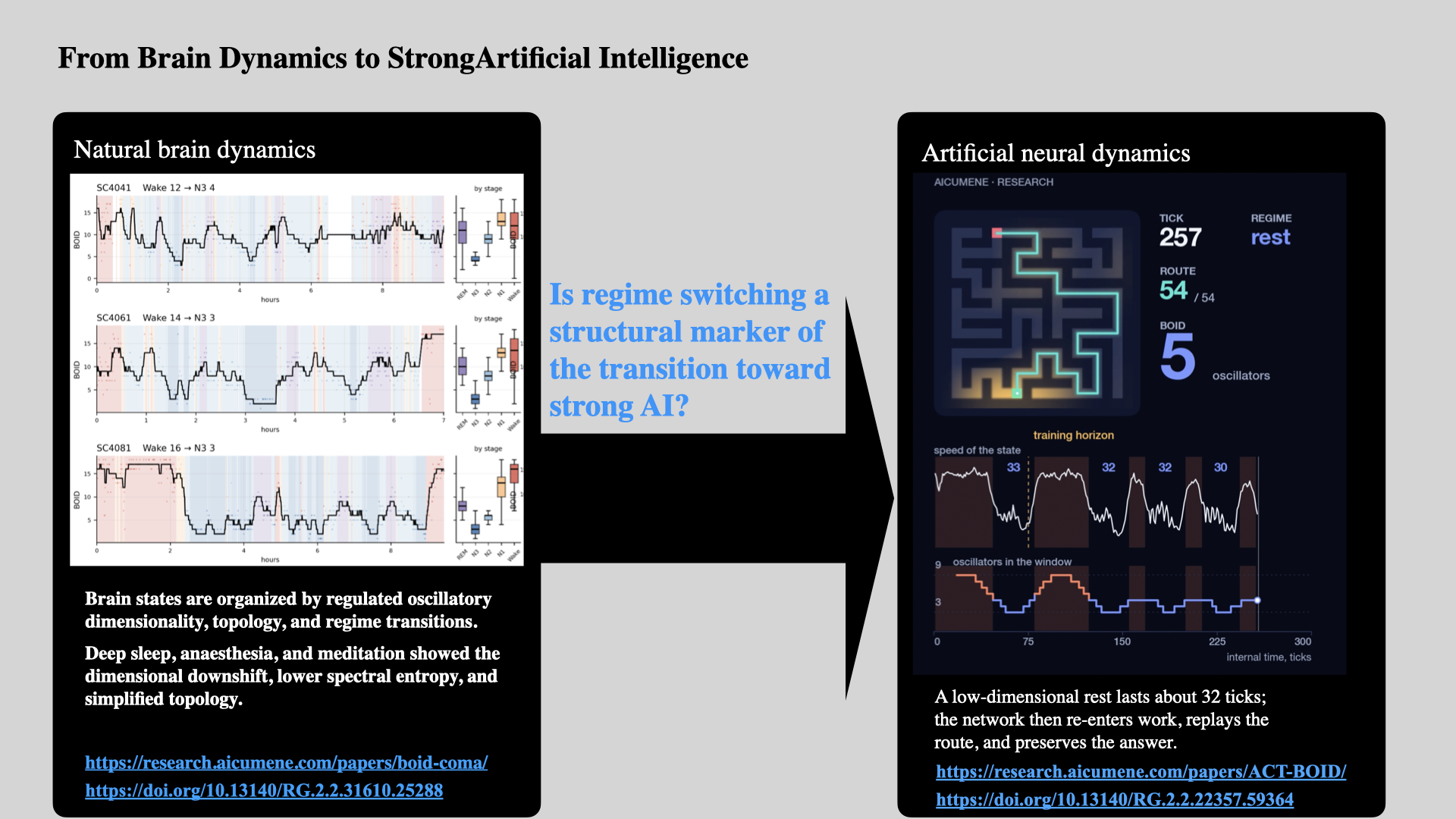
The structural programme is not only conceptual. In our work on BOID and MSSA, brain states such as wakefulness, sleep, meditation, anaesthesia, coma, and recovery are treated as objectively distinguishable regimes of oscillatory dimensionality, topology, and structural-dynamical organization [5, 3, 4]. In our work on brain and artificial-system regimes, we extend the same logic to trained artificial systems: cognitive and trained-system states are treated as organized regimes of regulated oscillatory dimensionality and functional regime switching [6]. This provides an experimental bridge from brain dynamics to artificial intelligence: intelligence is not inferred only from external performance, but from measurable internal organization. BOID and MSSA are therefore not merely signal-processing tools in this framework; they are early examples of NCP instruments: methods for converting cognitive and neural states into measurable structural objects.
These invariants shift the study of intelligence from external performance to the internal organization that generates, stabilizes, and transforms intelligent behaviour.
3.1.2 Strong AI as Structural Excess Rather Than Anthropomorphic Imitation
Thesis. Strong artificial intelligence should be defined not by anthropomorphic similarity, but by measurable structural excess: the emergence of internal dimensionality, topology, trajectories, and functional regimes that exceed the structural envelope of the products on which the system was trained.
In the New Cognitive Paradigm, intelligence is not unique to humans: biological, hybrid, and artificial systems may possess forms of intelligence, and artificial systems may already exceed natural intelligence in specific tasks. The relevant question is therefore not whether an artificial system behaves, speaks, or reasons like a human, but whether it develops measurable internal organization beyond imitation.
The strength of an artificial intelligence should be assessed through intrinsic dimensionality and topology [1], BOID and regulated regime structure [5, 6], MSSA-based oscillatory organization [3, 4], semantic trajectory geometry [22, 21, 20, 23], and dynamical invariants of trained artificial systems [6]. In this framework, the strength of intelligence is not a matter of human-likeness, but of measurable internal organization.
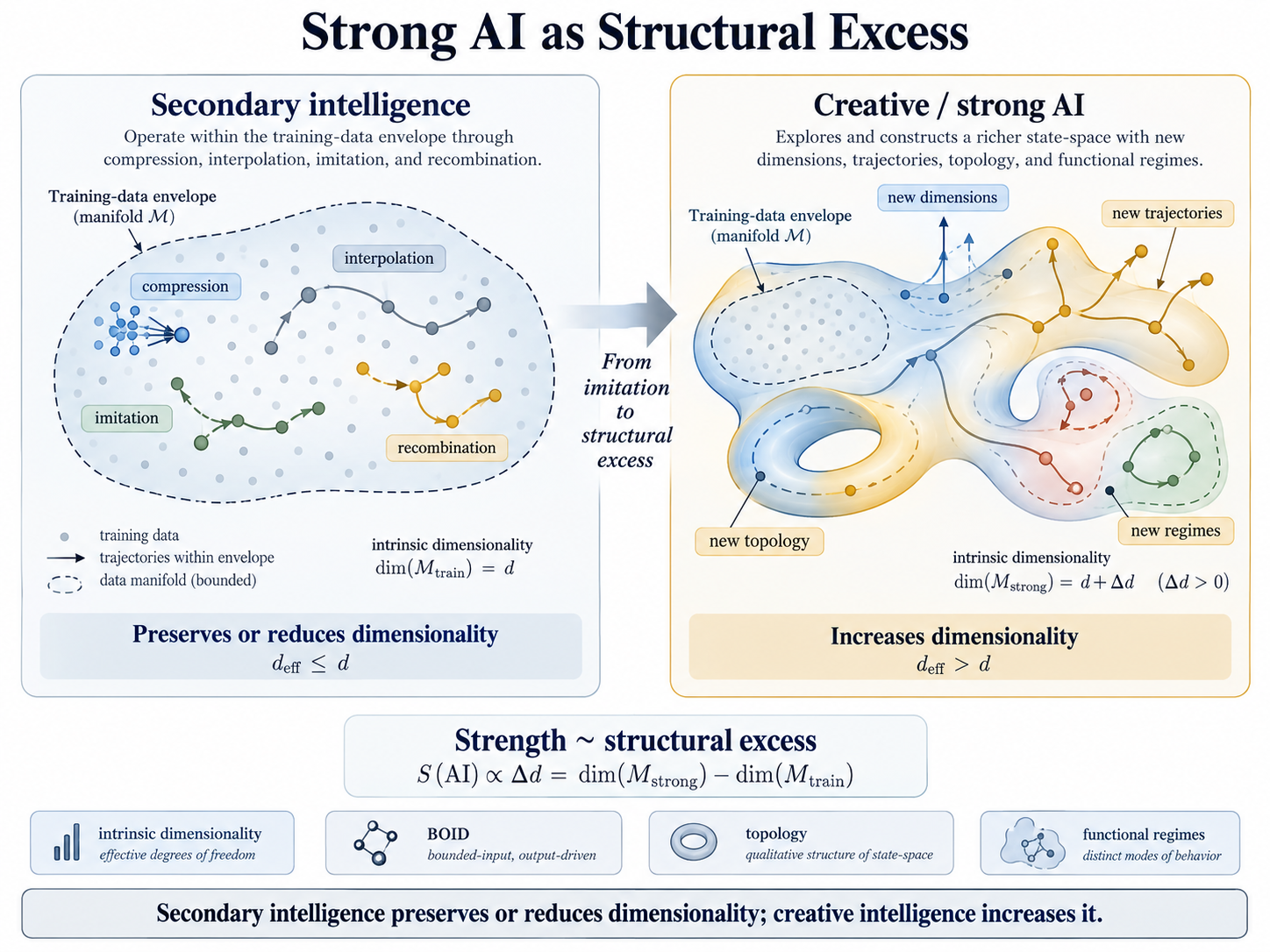
A system remains secondary when it merely compresses, interpolates, imitates, or recombines the structural space of the products on which it was trained. Such secondary reproduction tends to preserve or reduce effective dimensionality. By contrast, creativity corresponds to structural excess: the emergence of new internal dimensions, trajectories, topological relations, or admissible transformations not present as such in the training products.
A candidate structural criterion for strong artificial intelligence is therefore the appearance of measurable structural excess: the intrinsic dimensionality, topology, trajectory geometry, or functional regime structure of the artificial system, or of its generated products, becomes richer than the structural envelope of the corpus from which it learned. Such excess indicates not only recombination, but the generation of new information and new expressive structure (Figure 4).
Experimental basis.
Our experimental programme supports this criterion in two directions. First, brain-state studies show that biological cognition is organized by measurable changes in oscillatory dimensionality, topology, and regime structure rather than by behavioural labels alone [5, 3, 4]. Second, trained artificial systems can develop functional regimes, including work, rest, replay, memory-like persistence, recovery, and clock-like transitions, whose organization can be measured as dynamical invariants [6]. These results motivate the view that the transition toward strong AI should be sought not in human-like outputs, but in the emergence of internal regimes and structural novelty.
Thesis. Secondary intelligence preserves or reduces dimensionality; creative intelligence increases it.
Strong artificial intelligence should therefore not be understood as human-like intelligence, but as a system whose internal organization produces measurable novelty: higher-dimensional, topologically nontrivial, and functionally stable structures beyond the structural envelope of its training data.
3.2 Consciousness and Creativity
3.2.1 Consciousness and the Products of Consciousness as Structurally Measurable Patterns
Thesis. The New Cognitive Paradigm asserts the objective structural measurability of consciousness and the products of consciousness.
Consciousness and the products of consciousness should be treated not only as phenomenological, subjective, cultural, or interpretive phenomena, but also as structurally measurable patterns whose internal organization and external effects can be described through objective structural-dynamical properties, such as dimensionality, topology, complexity, regime structure, trajectories, and dynamics.
Consciousness, and its different states, should be treated as structurally measurable phenomena. In this framework, consciousness is not reduced to subjective report, phenomenological description, behavioural state, or neural correlate. These approaches remain important, but they do not exhaust the problem. Conscious and near-conscious states can in principle be distinguished from non-conscious states by objective structural-dynamical markers.
Experimental basis.
Analysis of brain signals obtained from brain–computer interfaces and related neural recordings suggests that states of wakefulness, sleep, meditation, anaesthesia, drug-induced unconsciousness, coma, and recovery can be distinguished not only subjectively, but also objectively, on the basis of their internal structural-dynamical organization. We have shown that different levels and regimes of consciousness, including light sleep, deep sleep, coma, anaesthesia, meditative states, recovery states, and other brain states, are characterized by differences in internal complexity, intrinsic dimensionality, Bernadotte Oscillator Intrinsic Dimension (BOID), topology, and regime-dependent dynamics [1, 5, 6, 3, 4]. The same structural reading extends to the topology of delay-embedded trajectories, whose geometry is an invariant of the generating dynamics and supports a topology-driven classifier of time series [13], and to the symbolic level, where regular events in a signal are recognized in real time by counter-augmented deterministic automata without state explosion [12, 11].
Thesis. The substrate of consciousness is defined by structural-dynamical properties rather than by biological exclusivity. Any system that satisfies the relevant internal structural conditions may become a candidate substrate for conscious or near-conscious dynamics.
Since the relevant properties of consciousness and non-consciousness are structural-dynamical, the substrate of consciousness should not be assumed in advance to be only a living biological system. In principle, any system that satisfies the relevant internal structural conditions may become a candidate substrate for conscious or near-conscious dynamics.
Experimental basis.
Human consciousness and waking states in humans and animals are characterized by higher structural-dynamical complexity and by switching between regimes of higher and lower complexity. Related forms of regime switching and functional differentiation can also be observed in some artificial systems [5, 6]. This does not imply that such systems are conscious in the human sense. Rather, it shows that the structural language used to describe consciousness can also be applied to non-biological and hybrid systems.
Thesis. Consciousness and non-consciousness may form a structural continuum.
The New Cognitive Paradigm does not assume a sharp boundary between consciousness and non-consciousness, or between animal, human, artificial, and hybrid forms of cognition.
It therefore introduces the term near-consciousness to denote intermediate structural regimes that may not satisfy the full criteria of consciousness, but cannot be adequately described as mere non-consciousness.
Near-consciousness is not a metaphor for vague awareness. It is a structural term for regimes in which some properties associated with consciousness may be present in partial, unstable, reduced, or non-human form: dimensional organization, regime switching, integration, recovery, memory-like persistence, or state-dependent transformation.
Thesis. Control of structural-dynamical properties makes it possible to control conscious and near-conscious regimes.
If consciousness and near-consciousness depend on structural-dynamical properties of a system, then the ability to modulate these properties opens the possibility of controlling conscious states, special forms of consciousness, and the state of a thinking system. This applies to biological systems through neurostimulation, neurofeedback, directed neuroplasticity, pharmacological modulation, and brain–computer interfaces. It may also apply to artificial systems through architecture, memory, recurrent dynamics, state-space organization, and controlled regime transitions.
If consciousness and its level of development are determined by structural-dynamical organization, then consciousness is not only an object of description, but also an object of directed modulation. The New Cognitive Paradigm therefore treats consciousness as trainable in principle: by inducing the appropriate structural regime, one may amplify attention, integration, memory-like persistence, recovery, semantic density, and the capacity for controlled state transitions (Figure 5).
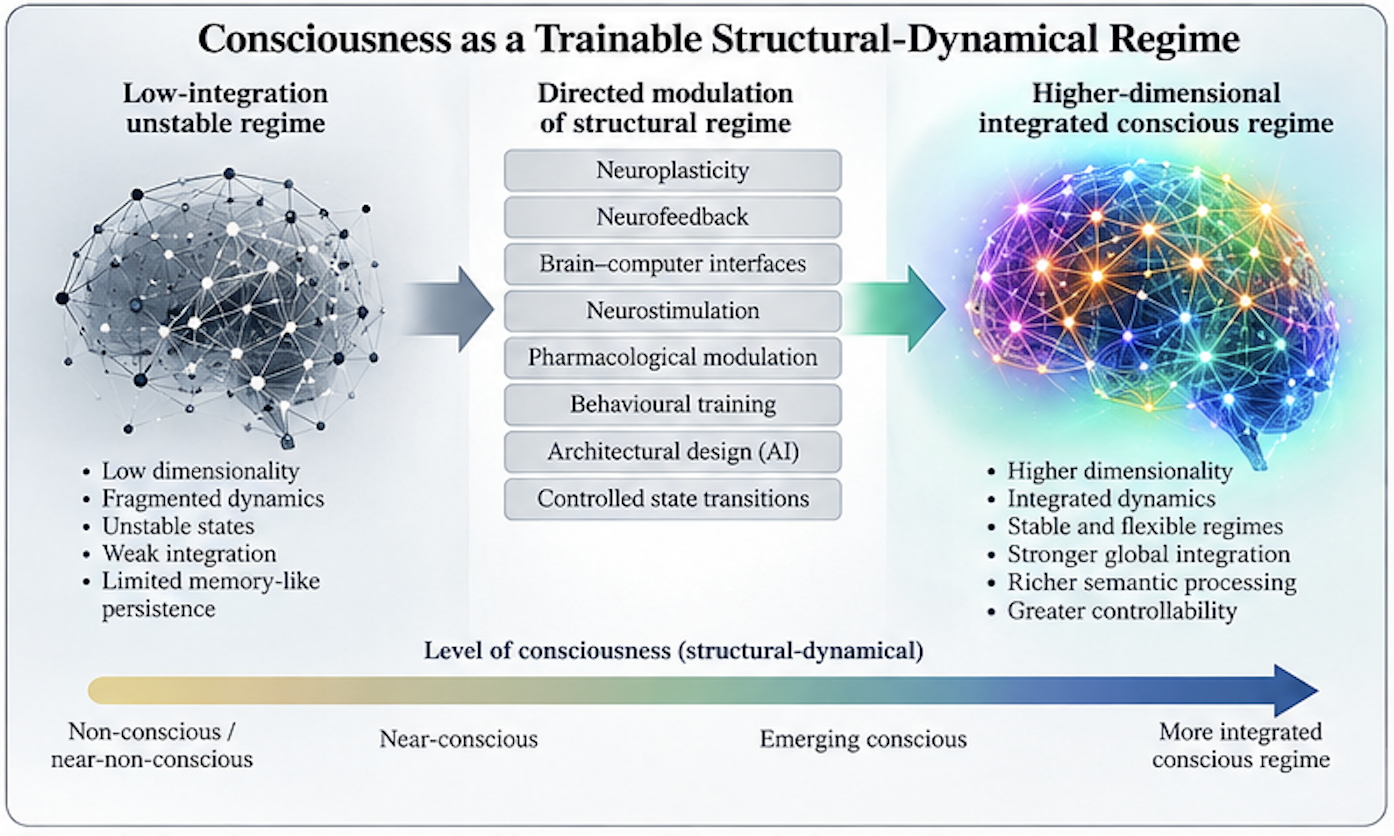
In biological systems, this may be achieved through directed neuroplasticity, neurofeedback, brain–computer interfaces, neurostimulation, and pharmacological or behavioural modulation. In artificial systems, analogous effects may be pursued through architecture, memory design, recurrent dynamics, regime control, and state-space organization.
Thesis. The principle of structural-dynamical evaluation applies to the products of consciousness.
The same principle applies to the products of consciousness: language, images, concepts, mathematical objects, scientific hypotheses, artistic works, plans, tools, institutions, and artificial patterns. Such products are not only objects of interpretation, cultural reception, or behavioural effect. They possess internal structure.
A text, image, theory, or work of art can be studied through intrinsic dimensionality, topology, sparsity, fractality, Kolmogorov complexity, semantic density, trajectory geometry, and admissible transformations.
Experimental basis.
This connects the April Theses with semantic-trajectory approaches in language geometry [22, 21, 20, 23] and with structural criteria for intelligence [1].
Thesis. Creativity can be evaluated by the complexity of its internal organization, its distance from existing patterns, the novelty of the structural space it opens, and the transformations it makes possible in a receiving subject or object.
Creativity is a special case of this structural-dynamical measurability. A creative product can be evaluated by the complexity of its internal organization, its distance from existing patterns, the novelty of the structural space it opens, and the transformations it makes possible in a receiving subject or object.
Originality is therefore not merely a matter of subjective impression. It can be approached structurally: as low similarity to existing patterns, the emergence of a new topology, unusual trajectory geometry, unexpected compression, expansion of expressive dimensionality, or the creation of new admissible transformations.
Secondary production preserves, compresses, interpolates, or recombines existing structures. Creative production changes the space of possible structures.
Thesis. Consciousness and its products do not only represent or signify; they act. The force of a message can be measured through the change it produces in the receiving system.
Consciousness and its products are not only interpreted; they act. Their structure can be measured internally, and their force can be evaluated by how strongly, how persistently, and in what direction they transform a receiving system.
The force of a message, text, image, symbol, signal, or pattern can be measured through the change it produces in the receiving system. A strong message is not only aesthetically impressive, emotionally intense, or rhetorically persuasive. It measurably changes the state of a subject or object: it reorganizes an internal representation, shifts attention, induces action, stabilizes memory, changes belief, opens a new semantic trajectory, or transforms the topology of future interpretations.
In artificial systems, a pattern may change latent states, policies, memory structures, representations, or functional regimes. Thus, the force of impact is not merely rhetorical or cultural. It is a measurable transformation of state.
Thus, the New Cognitive Paradigm treats consciousness, creativity, and the products of consciousness as structurally measurable patterns: internally organized, externally active, and capable of transforming the systems that receive them.
3.2.2 New Cognitive Modernity is a Measurable Creative Expansion.
Thesis. New Cognitive Modernity is a Measurable Creative Expansion.
The New Cognitive Paradigm marks a transition into a new cognitive modernity: an era in which cultural, intellectual, and creative products become measurably higher-dimensional through new languages, intercortical communication, consciousness modulation, directed neuroplasticity, and human–AI fusion.
Postmodernity and metamodernity were largely defined by relations to meaning: fragmentation, irony, plurality, oscillation, reconstruction, and reflexive distance. The New Cognitive Paradigm shifts the question from interpretation to structure and dynamics. It treats cultural and creative evolution not only as a change in style, sensibility, or historical position, but as a measurable transformation in the dimensionality, topology, semantic density, trajectory diversity, and transformative force of the products of consciousness.
In this sense, the coming era is not merely post-postmodern or metamodern. It is a new cognitive modernity. Its defining feature is the expansion of the spaces in which thought, language, art, intelligence, and consciousness can operate. This expansion is driven by new symbolic, embedding-based, and intercortical languages; by artificial systems capable of generating non-anthropomorphic semantic structures; by modulation of conscious states; by directed neuroplasticity; and by the progressive coupling of human cognition with artificial intelligence.
The measurable signature of this transition is the emergence of creative products that open new dimensions, semantic routes, perceptual regimes, and forms of state transformation. Secondary cultural production preserves, recombines, ironizes, or reinterprets existing structures. Cognitive-modern production expands the structure of what can be thought, expressed, perceived, and transmitted.
Thesis. Postmodernity multiplies interpretations; metamodernity oscillates between positions; New Cognitive Modernity increases the dimensionality of consciousness and its products.
Thus, the transition into a new modernity is not only a historical or aesthetic claim. It is a structural claim: if new languages, intercortical communication, directed neuroplasticity, consciousness modulation, and human–AI coupling increase the dimensionality and topology of creative products, then cultural evolution itself becomes measurable as a transformation of cognitive space.
3.3 Language
3.3.1 Language is a Semantic State Transfer
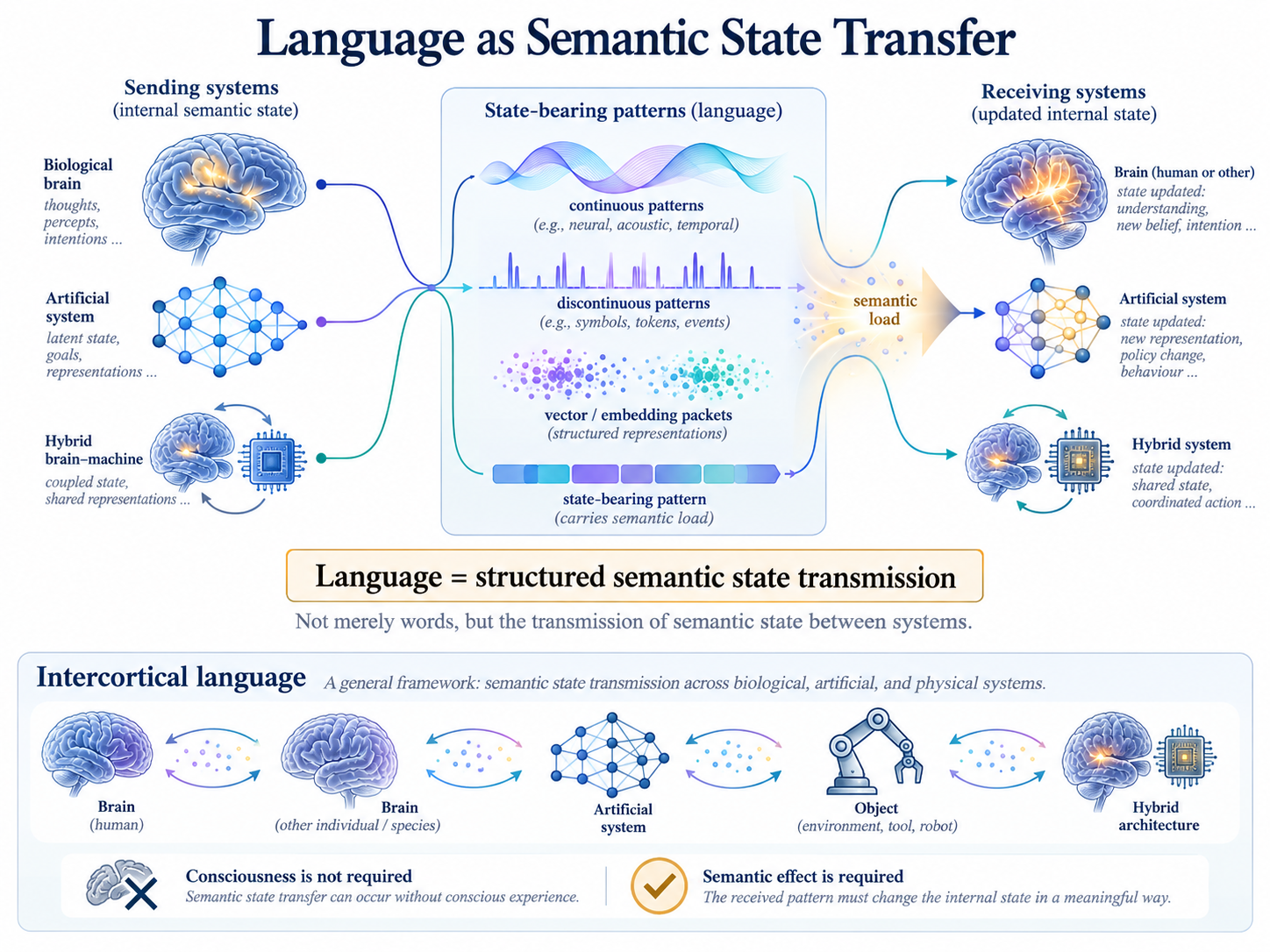
In the New Cognitive Paradigm, language is not defined by words, symbols, or conscious intention, but by the transmission of semantic state between systems.
Thesis. Language is a class of continuous or discontinuous patterns carrying semantic load and capable of changing the state of a receiving system in a structured and interpretable way.
We define intercortical language as a new type of language in which communication occurs through continuous or intermittent embeddings exchanged between subjects, objects, biological brains, artificial systems, or hybrid brain-machine architectures. Consciousness is not a necessary condition for language use; the necessary condition is the transfer of a state-bearing pattern that produces a semantic effect. In this sense, language is not primarily a property of consciousness, but a protocol of semantic state transmission.
The NCP also extends the concept of language beyond human-to-human communication. It includes intercortical languages between biological brains, hybrid languages between brains and artificial systems, and machine-to-machine languages that may never pass through human-readable symbols. A machine language in this sense is not merely a programming syntax or communication protocol, but a structured transfer of internal state between artificial systems. Such languages may be vectorial, symbolic, oscillatory, multimodal, topological, or regime-based. Their value is not determined by human readability, but by their capacity to transmit, transform, and stabilize states across systems. A language does not need to be human-readable in order to be cognitively real (Figure 6).
3.3.2 Languages as Measurable Expressive Geometries
Thesis. Languages are not equivalent symbolic containers for the same meanings. Different languages may possess different internal structures: intrinsic dimensionality, topology, sparsity, fractality, curvature, trajectory geometry, semantic density, and admissible transitions.
These properties determine what kinds of states, relations, objects, and transformations a language can express, and with what degree of precision, compression, ambiguity, or generative freedom.
For anthropocentric languages, fractality and sparsity may be treated as detectable topological features of semantic organization: meanings form dense regions, sparse regions, recursive patterns, self-similar structures, and preferred semantic trajectories. For artificial languages, these properties may take different forms. A non-human system may develop a language whose topology is shaped not by human speech, but by its architecture, memory, state complexity, and functional demands.
This is essential for strong artificial intelligence. An artificial system is not required to inherit human language as its primary medium of internal organization. It may form, select, or optimize a continuous, discontinuous, symbolic, vectorial, multimodal, intercortical, or hybrid language according to the expressive complexity of its own states. In the New Cognitive Paradigm, anthropomorphism is not a principle of strong AI: the question is not whether a system speaks like a human, but whether it has a language with sufficient internal dimensionality, topology, and expressive power to represent, transform, and transmit its states.
3.3.3 Language as a Trajectory Space
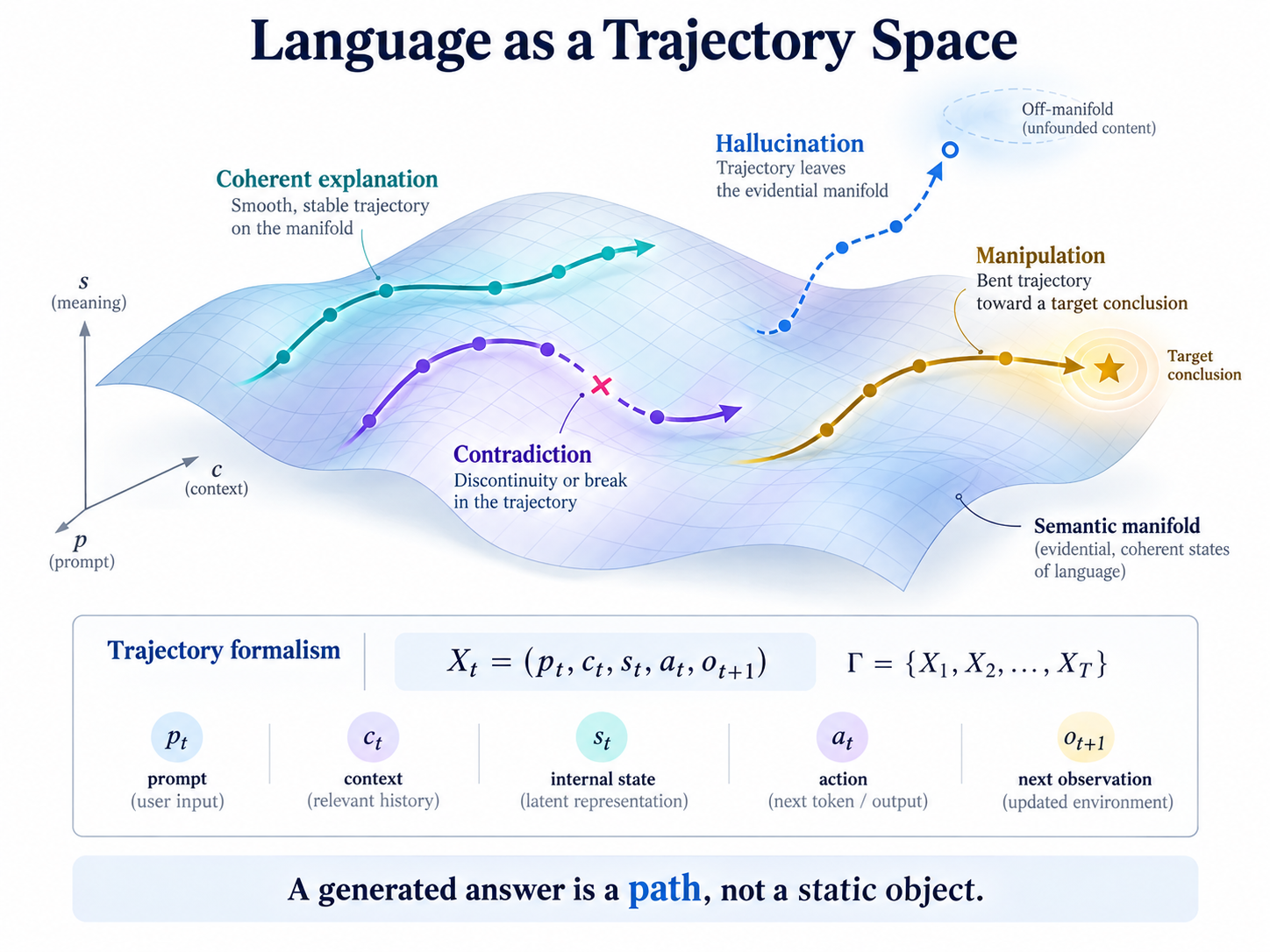
Language should not be treated merely as a sequence of tokens. It should be treated as a space of trajectories. When a human or an artificial system produces language, it moves through semantic space: a coherent explanation follows a stable trajectory, a contradiction produces a discontinuity, a hallucination may leave the evidential manifold, and manipulation may deform the semantic route toward a desired conclusion.
A simplified representation is where is the prompt or local linguistic input, is the context, is the internal state, is the generated action or token-level move, and is the next observation or semantic consequence. A generated answer is therefore not a static object, but a path:
This representation connects the April Theses to semantic-trajectory approaches in language geometry and bot-detection work [1, 22, 21, 20, 23].
3.4 Truth
3.4.1 Probabilistic Truth as Measurable Epistemic Status
The April Theses of the NCP introduce probabilistic truth, which is not the multiplicity of truth or relativism.
The April Theses use the concept of probabilistic truth, to describe this operational truth-status: where denotes evidence, denotes context, denotes the system state, and denotes the reliability of the retrieval, reasoning, or generation process.
Thesis. Probabilistic truth is the measurable epistemic status of truth-access under conditions of incomplete information, limited provenance, contextual dependence, and generative uncertainty.
In classical logic, truth is often treated as binary: a statement is true or false. This binary ideal remains necessary for science, law, mathematics, and factual reasoning. However, in a world shaped by generative artificial intelligence, truth is increasingly encountered not as an immediately binary phenomenological experience, but as an epistemic condition that must be reconstructed from evidence, context, provenance, system state, and process reliability.
This does not mean that truth becomes arbitrary, subjective, or multiple. The April Theses do not claim that there are many truths in the relativistic sense. Rather, they describe a new epistemic situation: the subject receives statements whose evidential basis may be incomplete, whose provenance may be hidden, whose context may shift, and whose generation may involve probabilistic inference, retrieval, recombination, hallucination, or compression. The uncertainty belongs not to truth itself, but to our access to the truth-status of generated statements.
A generated statement may be true, false, partially supported, contextually valid, outdated, unverifiable, copied, inferred, hallucinated, or correct for the wrong reason. Therefore, the relevant question is not only whether the statement is true, but how its truth-status can be operationally measured (Figure 8).
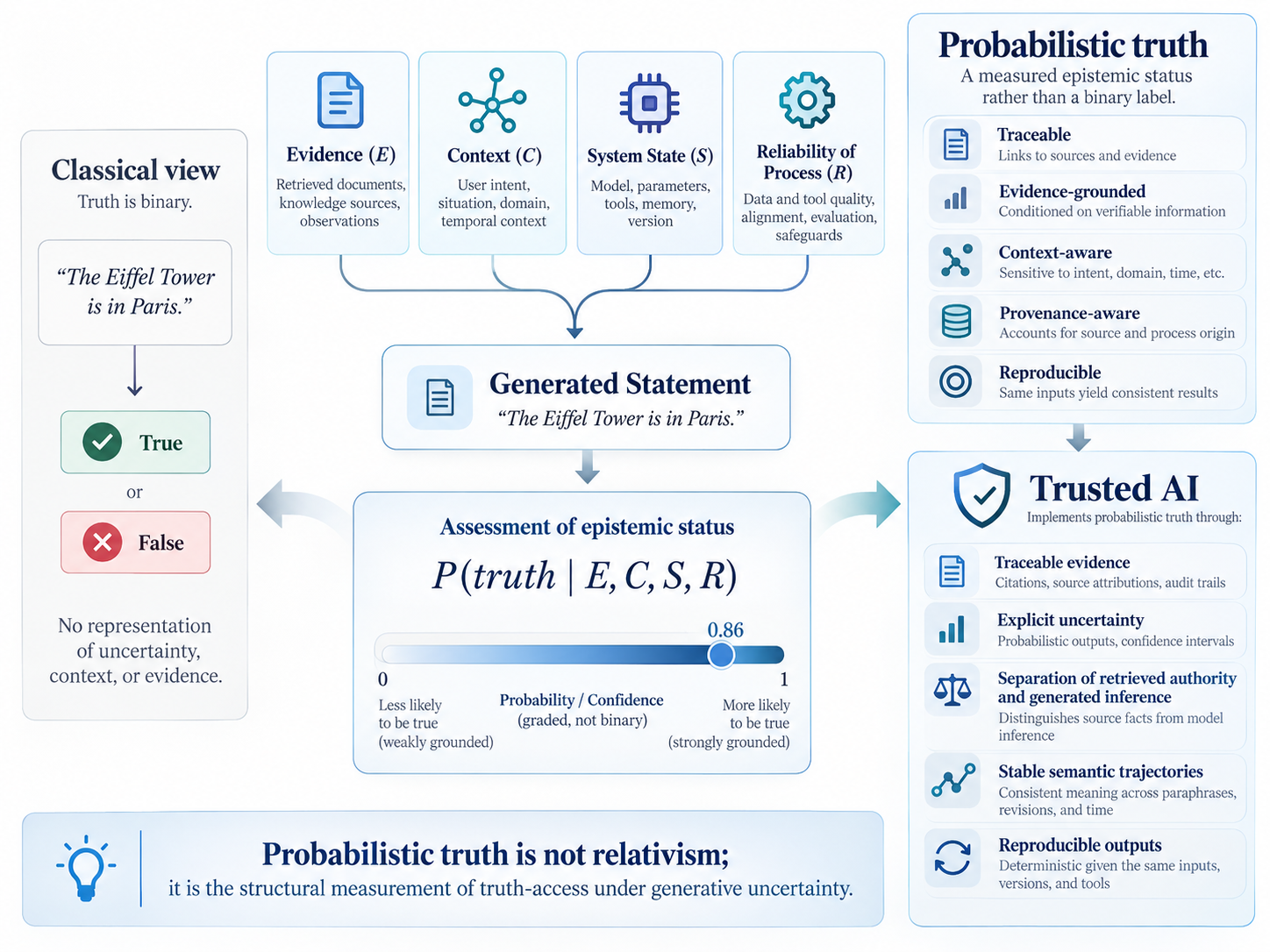
This formula does not replace truth with probability. It describes measurable epistemic access to truth under conditions where evidence, context, provenance, and process reliability are incomplete or variable. A statement becomes more truth-grounded when its evidence is traceable, its context is explicit, its provenance is known, its reasoning path is reproducible, and its claim remains stable under changes of prompt, source, and system state.
In this sense, probabilistic truth is a philosophical thesis about the post-generative epistemic condition. We begin to live in a world where truth is no longer experienced phenomenologically as a simple binary property of an utterance. A fluent statement may be ungrounded; a hesitant statement may be more reliable; a plausible statement may be hallucinated; an uncertain statement may be epistemically honest. Truth therefore becomes something that must be reconstructed through process, evidence, and structure.
Probabilistic truth is not relativism. It is the structural measurement of truth-access under conditions of generative uncertainty.
Trusted AI.
Probabilistic truth becomes operational in the architecture of trusted AI. If the truth-status of a generative output depends on evidence, context, system state, provenance, and process reliability, then a trusted AI system must expose these elements rather than hide them behind fluent language. A trusted AI system should provide traceable evidence, explicit uncertainty, stable semantic trajectories, separation between retrieved authority and generated inference, reproducible outputs under comparable conditions, and controlled transitions between internal regimes. Bounded, verifiable components of this kind already exist in our own engineering practice and serve as reference points for the programme: the vessel-segmentation network VeNet, a compact model with explicitly structured computation [15], trained on a small annotated dataset published for independent reuse [16].
In this framework, hallucination is not merely a wrong sentence, but a failure of evidential grounding and trajectory stability. Manipulation is not merely a harmful output, but a deformation of the semantic trajectory toward a desired conclusion. Loss of context is not merely a memory bug, but a breakdown of trajectory continuity. Trusted AI therefore cannot be reduced to output filtering: truth is not merely a property of the final sentence, but a measurable property of the evidential, semantic, and computational process that produced it.
4. Scope and Limitations
The New Cognitive Paradigm does not claim that consciousness, truth, language, or intelligence are exhausted by structural measures. It claims that they become partially and operationally addressable through structural-dynamical invariants. The framework should therefore be read not as a reduction of cognition to numbers, but as a programme for making cognition measurable where previous paradigms left it phenomenological, behavioural, or interpretive.
The NCP also does not claim that any artificial system displaying functional regimes is conscious in the human sense. Rather, it introduces a structural vocabulary for comparing biological, artificial, and hybrid systems without assuming in advance that human phenomenology is the only possible reference point. Its concepts—near-consciousness, ersatz-consciousness, epsilon-forms, semantic trajectories, and probabilistic truth—are intended as diagnostic instruments, not as final ontological verdicts.
5. Conclusion
The April Theses of the New Cognitive Paradigm propose that the next stage in the study of intelligence will not be defined by better imitation of human behaviour, but by the ability to measure the internal structures that make cognition possible. The decisive object is no longer the answer, the utterance, the behaviour, or the appearance of consciousness, but the structural organization that produces them.
This shift changes the criterion of strong artificial intelligence. A system should not be called strong because it speaks like a human, behaves like a human, or passes human-designed tests. Strong AI begins where imitation becomes insufficient: where a system develops measurable structural excess beyond the envelope of its training data. Secondary intelligence preserves, compresses, interpolates, or recombines existing structures; creative strong intelligence increases dimensionality, opens new trajectories, creates new topologies, and stabilizes new functional regimes.
The same transformation applies to consciousness. Consciousness is not reduced here to behaviour, self-report, neural correlation, or philosophical description. It is treated as a candidate structural-dynamical regime. This makes it possible to introduce near-consciousness, ersatz-consciousness, and the near-human not as metaphors, but as diagnostic categories. The uncanny valley becomes a measurement zone: the place where anthropomorphic appearance diverges from internal organization, and where the difference between imitation and subjecthood can be studied.
If consciousness and its level of development are determined by structure and dynamics, then consciousness is not only measurable, but also modifiable. The New Cognitive Paradigm therefore opens the possibility of directed enhancement of consciousness: inducing, stabilizing, and amplifying desired conscious or near-conscious regimes through directed neuroplasticity, neurofeedback, brain–computer interfaces, neurostimulation, pharmacological modulation, and controlled regime transitions. Consciousness becomes not only a mystery to be described, but a structural regime that can, in principle, be trained.
Language is also displaced from its classical role as representation. In the NCP, language is a protocol of semantic state transfer and a space of trajectories. This includes not only human language, but also intercortical languages between biological brains, hybrid brain–machine languages, and machine-to-machine languages that may not be reducible to human-readable symbols. A generated answer is not a static text, but a path through semantic space. Coherence, contradiction, hallucination, manipulation, and grounding can therefore be treated as structural properties of trajectories, not merely as surface qualities of sentences.
Truth undergoes the same structural turn. Probabilistic truth is not relativism and not the multiplication of truth. It is the measurable epistemic status of truth-access under conditions of incomplete evidence, shifting context, hidden provenance, and generative uncertainty. Trusted AI is the practical architecture that follows from this: a system becomes trustworthy not by sounding fluent, but by exposing evidence, uncertainty, provenance, semantic stability, reproducibility, and the separation between retrieved authority and generated inference.
The New Cognitive Paradigm therefore does not merely add new terminology to existing AI theory. It changes the level at which cognition is evaluated and intervened upon. Intelligence, consciousness, language, creativity, and truth become structurally measurable phenomena. The epsilon-operator, the ersatz-operator, and the operator of measurability define the instruments of this shift: they allow us to work near inaccessible essences, distinguish functional substitution from ontological identity, and turn previously subjective or interpretive phenomena into objects of structural diagnosis and directed transformation.
The central claim of the April Theses is that the post-generative era requires a new science of cognition: one capable of measuring dimensions, regimes, trajectories, topologies, transformations, and truth-access. If the twentieth century asked whether machines could think, the New Cognitive Paradigm asks a sharper question: what internal structure must exist for thinking, consciousness, language, creativity, and truth to become more than appearance?
References
- [1] Bernadotte, A. & Gromov, V. A. What Is Strong AI? Intrinsic Structural Criteria for Strong Intelligence Based on Dimensionality and Topology. Aicumene preprint 2025.043 (v1, August 2025; v2, October 2026, SSRN forthcoming). https://doi.org/10.13140/RG.2.2.12211.59681. https://research.aicumene.com/papers/StrongAI/.
- [2] Bernadotte, A. & Menshikov, I. Trusted and Safe Technologies of Generative Artificial Intelligence. Aicumene manuscript, 2026, in preparation (to be merged into Safe AI by Design).
- [3] Bernadotte, A. & Menshikov, I. Multichannel Singular Spectrum Analysis: Counting Oscillatory Modes and Recovering Their Spatial Loadings. Aicumene preprint 2026.044v2; SSRN working paper 7693202, November 11, 2026. https://research.aicumene.com/papers/MSSA/. doi:10.2139/ssrn.7693202.
- [4] Bernadotte, A. & Menshikov, I. From Oscillatory Modes to Source Geometry: Identifiability and Localization in Multichannel Time Series. Aicumene preprint 2026.058v1; SSRN working paper 7716058, November 2026. https://research.aicumene.com/papers/source-geometry/. doi:10.2139/ssrn.7716058.
- [5] Bernadotte, A. & Menshikov, I. Brain Oscillator Intrinsic Dimension Marks Consciousness, Recovery Mode, and Failed Downshifting in Coma. Aicumene preprint 2026.042 (v1, July 2026; v2, October 2026, SSRN, number pending). https://research.aicumene.com/papers/boid-coma/. doi:10.13140/RG.2.2.31610.25288.
- [6] Bernadotte, A. & Menshikov, I. From Brain Dynamics to Strong Artificial Intelligence: Learning Creates Functional Regime Switching. Aicumene preprint 2026.045 (v1, October 4, 2026; v2, October 24, 2026, revised November 20, 2026); SSRN working paper 7733442, doi:10.2139/ssrn.7733442. https://research.aicumene.com/papers/BOID-JEPA/. doi:10.13140/RG.2.2.22357.59364.
- [13] Bernadotte, A. Topology-driven classification of time series. bioRxiv 2026.04.25.720787, 2026. doi:10.64898/2026.04.25.720787.
- [8] Bernadotte, A. & Buchstaber, V. Method for Evaluating the Number of Signal Sources and Application to Non-Invasive Brain–Computer Interface. arXiv preprint arXiv:2410.11844, 2024. doi:10.48550/arXiv.2410.11844.
- [9] Bernadotte, A. Estimating the Number of Sources in EEG Signals Based on Hankel Matrices for Brain–Computer Interface Applications. In Proceedings of the 12th International Conference on Automation, Robotics and Applications (ICARA), pp. 621–626, 2026. doi:10.1109/ICARA69401.2026.11480398.
- [10] Menshikov, I., Elfimov, V. & Bernadotte, A. A Lightweight Hankel-Embedded Pipeline for Real-Time EEG Filtering and Classification. In Proceedings of the 12th International Conference on Automation, Robotics and Applications (ICARA), pp. 589–593, 2026. doi:10.1109/ICARA69401.2026.11480292.
- [11] Bernadotte, A. Counter-Augmented Deterministic Automata for Real-Time Regular Expression Matching Without State Explosion. In Proceedings of the 12th International Conference on Automation, Robotics and Applications (ICARA), pp. 471–475, 2026. doi:10.1109/ICARA69401.2026.11480280.
- [12] Bernadotte, A. Real-time Regular Expression Matching. arXiv:2308.10208, 2023. doi:10.48550/arXiv.2308.10208.
- [13] Bernadotte, A. Topology-driven classification of time series. bioRxiv 2026.04.25.720787, 2026. doi:10.64898/2026.04.25.720787.
- [14] Bernadotte, A. Structural Modification of Finite State Machines for Signal-Image Conversion and Natural Language Processing. Programmnaya Ingeneria 13, 449–461, 2022. doi:10.17587/prin.13.449-461.
- [15] Bernadotte, A. VeNet: A Lightweight Neural Network for Efficient Brain Vessel Segmentation in Endovascular Robotic Surgery. Scientific Reports, 2026. doi:10.1038/s41598-026-54176-x.
- [16] Bernadotte, A., Elfimov, V. & Menshikov, I. Semi-Automatic Annotation of Brain Vessels in Magnetic Resonance Angiography Images. Scientific Data 13, 41, 2026. doi:10.1038/s41597-025-06354-1.
- [17] Menshikov, I., Orlov, K., Berestov, V. & Bernadotte, A. Preoperative Personalized Vascular 3D Simulator of Intelligent Robotic Ecosystem LevshaAI for Endovascular Interventions. In Proceedings of the International Conference on Automation, Robotics and Applications (ICARA), pp. 6–10, 2023. doi:10.1109/ICARA56516.2023.10125981.
- [18] Menshikov, I. & Bernadotte, A. Intelligent Robotic Motion Copying System LevshaAI for Remote Endovascular Interventions with Haptic Feedback. In Proceedings of the IEEE International Conference on Cyborg and Bionic Systems (CBS), pp. 386–391, 2023. doi:10.1109/CBS55922.2023.10115398.
- [19] Bernadotte, A. Cyber Security for Surgical Remote Intelligent Robotic Systems. In Proceedings of the International Conference on Automation, Robotics and Applications (ICARA), pp. 65–69, 2023. doi:10.1109/ICARA56516.2023.10126050.
- [20] Gromov, V. A. & Dang, T. Spot the Bot: Distinguishing Human-Written and Bot-Generated Texts Using Clustering and Information Theory Techniques. In Pattern Recognition and Machine Intelligence, pp. 20–27, 2023. doi:10.1007/978-3-031-45170-6_3.
- [21] Gromov, V. A. & Kogan, A. S. Spot the Bot: Coarse-Grained Partition of Semantic Paths for Bots and Humans. arXiv preprint arXiv:2402.17392, 2024. arXiv:2402.17392.
- [22] Gromov, V. A. & Dang, T. Semantic and Sentiment Trajectories of Literary Masterpieces. Chaos, Solitons & Fractals 175, 113934, 2023. doi:10.1016/j.chaos.2023.113934.
- [23] Gromov, V. A., Dang, T. & Yerbolova, A. A Language and Its Holes: The First-Order Homology of the Large-Scale Geometrical Structure of a Natural Language. Complexity 2025, 9659172, 2025. doi:10.1155/cplx/9659172.
- [24] Gromov, V. A., Borodin, N. S. & Yerbolova, A. S. A Language and Its Dimensions: Intrinsic Dimensions of Language Fractal Structures. Complexity 2024, 8863360, 2024. doi:10.1155/2024/8863360.
- [25] Gromov, V. A., Dang, Q. N., Kogan, A. S. & Yerbolova, A. S. Spot the Bot: The Inverse Problems of NLP. PeerJ Computer Science 10, e2550, 2024. doi:10.7717/peerj-cs.2550.